
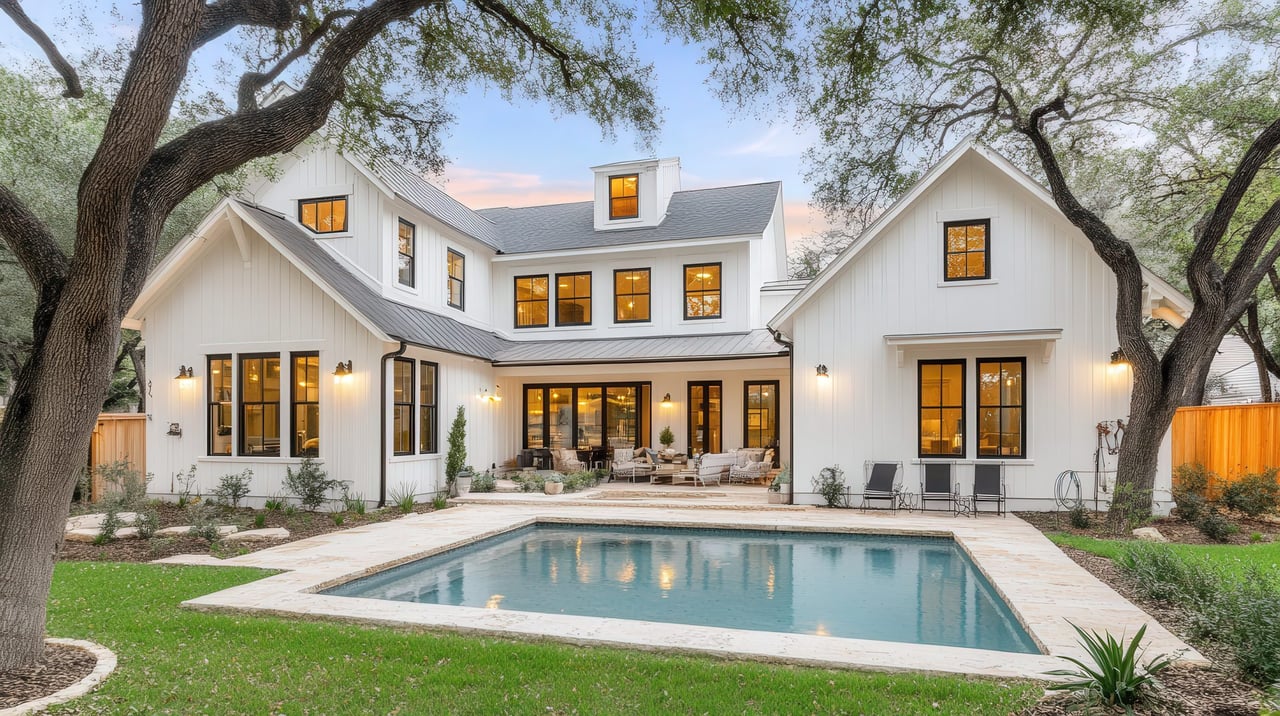
A $3 million home in Austin's luxury market can carry annual property taxes ranging from roughly $46,700 in Westlake Hills to more than $52,400 in the Lake Travis corridor before accounting for insurance, HOA dues, club memberships, utilities, or the upkeep that comes with large Hill Country properties. Two homes with similar purchase prices can differ by tens of thousands of dollars a year in recurring ownership costs depending on the exact address and the districts that serve it. Property taxes are only one part of the equation.
Insurance premiums, MUD assessments, private club obligations, pool and landscape maintenance, and infrastructure such as wells or septic systems all contribute to the true cost of ownership. Understanding those expenses upfront helps buyers evaluate affordability more accurately and avoid surprises after closing.
What Makes Up the Annual Carrying Cost of an Austin Luxury Home?
Six recurring cost categories drive the annual number on a $1.5M to $5M home in the West Austin and Hill Country corridor: property tax, property insurance, HOA or POA dues, mandatory club memberships where they apply, MUD or PID levies, and the maintenance of grounds and building systems that mass-market homes simply do not have.
Not every row applies to every address. A Westlake Hills home inside city limits with municipal water and no HOA carries a very different stack than a Lake Travis corridor property sitting inside a MUD with a mandatory club obligation. The point of budgeting parcel by parcel, rather than by submarket average, is that two homes at the same price can differ by five figures a year on recurring cost alone. Reading those differences before an offer is written is local knowledge that matters more to a relocating buyer than any published metro average.
How Much Is Property Tax on a $1.5M to $5M Austin Home?
Texas has no state property tax. Your bill is the sum of independently set rates from the county, county-adjacent taxing entities, city, and school district, all applied to the value certified by the county appraisal district. Travis Central Appraisal District covers most of this corridor, with Hays CAD and Williamson CAD covering adjacent areas.
For 2025, the main tax layers include:
County and county-adjacent entities: Travis County levies $0.375845 per $100 of value, up 8.0% year over year. Austin Community College adds $0.1049, while the Travis County Healthcare District adds roughly $0.105573. Together, these layers total about $0.586 per $100 before city or school taxes.
School districts: These make up the largest portion of the bill and vary considerably by submarket.
Eanes ISD: $0.8322 per $100 for 2025–26, down from $0.8855 the prior year. It covers Westlake, Rollingwood, and much of Barton Creek and West Lake Hills.
Lake Travis ISD: $1.0397 per $100 for 2025–26, its lowest rate in district history but still roughly 25% above Eanes. It covers Bee Cave, Spanish Oaks, Lakeway, and the Lake Travis corridor.
Austin ISD: $0.9252 per $100 for 2025–26, covering other parts of Barton Creek and West Austin.
City taxes: These are comparatively smaller.
West Lake Hills: $0.176783 per $100 for FY2025–26.
Lakeway: $0.16964 per $100 for 2025.
Bee Cave: $0.02 per $100, a rate the city has maintained for more than 20 consecutive budget cycles.
Here is how those layers combine at three representative home values, with the $140,000 homestead exemption applied only to ISD taxable value:
These are modeled figures based on published 2025 adopted rates certified through August and September 2025, not a bill from any specific parcel. Actual bills depend on the precise taxing units serving an address, which can include additional emergency services districts or road districts layered on top. Confirm the exact taxing units with the county appraisal district before you budget. If you are still weighing which submarket fits, the rate spread between Eanes and Lake Travis is one of several reasons the neighborhood-level view matters more here than a metro average ever will.
Why Does the Homestead Exemption Barely Move the Needle at This Price?
The general residence homestead exemption is a flat dollar reduction, which is exactly why it fades at the top of the market. Texas voters approved raising it from $100,000 to $140,000 in November 2025 through Senate Bill 4 and SJR 2, retroactive to the 2025 tax year, with a combined exemption up to $200,000 for owners 65 and older or disabled.
At the $1.5M to $5M tier, that fixed reduction shaves the same $140,000 off ISD taxable value whether the home is worth $1.5 million or $5 million. Its relative effect collapses from roughly 5% to 6% of the total bill at $1.5M to under 2% at $5M.
File it anyway, and file it promptly, because filing is what starts the mechanism that actually matters. A few points on the mechanics are worth stating plainly, since they are widely misreported:
Filing is one time: Once granted, the exemption renews automatically. You do not re-file annually. Appraisal districts must verify homestead status at least once every five years.
April 30 is the on-time date, not a cliff: Missing it does not forfeit the benefit.
Late applications are accepted: Generally up to two years after the delinquency date, with a refund of tax overpaid in the interim, under the Texas Comptroller's exemption rules.
The exemption is a property-tax filing: It’s entirely separate from the driver's license and vehicle registration rules that govern Texas residency.
What actually governs your multi-year trajectory is Texas Property Tax Code Section 23.23, the 10% annual appraisal cap. The cap limits how much a homesteaded property's taxable appraised value can rise year over year. Market value can rise faster; only the capped taxable value determines the tax base until it converges with or exceeds market value. New improvements such as an addition or a new pool are added outside the cap. Ordinary repairs are not.
The cap does not apply in your first year of ownership. Under Section 23.23(c), the limitation takes effect on January 1 of the tax year following the first tax year the owner qualifies the property for the exemption. A buyer who closes and homesteads in 2026 is appraised at full market value for 2026, and the cap only begins constraining increases from January 1, 2027. That gap year often produces a large one-time jump in taxable value relative to the prior owner's capped basis, and it catches relocating buyers who assumed the seller's tax bill was a reliable forecast of theirs.
Over a long hold, the cap becomes the dominant lever precisely because its dollar benefit scales with home value and with tenure. A state analysis found households in the highest income quintile capture nearly 40% of the roughly $490.6 million in statewide savings the cap generates, versus about 23% for the bottom three quintiles combined. How the cap interacts with your own basis, holding period, and any planned improvements is a question for your CPA, not a rule of thumb.
What Does It Take to Protest a High-Value Appraisal in Travis County?
The statewide deadline to file a Notice of Protest is May 15, or 30 days after the appraisal district mails the Notice of Appraised Value, whichever is later. Travis Central Appraisal District's protest process runs in two stages:
Informal review: A meeting with a TCAD appraiser, where the dispute may be resolved at a negotiated value.
Formal hearing: If unresolved, the case moves to the Appraisal Review Board, where an independent panel renders a binding administrative decision.
Owners must appear in person, by affidavit, through an agent, or by pre-scheduled phone hearing, or the protest is dismissed.
High-value and architecturally unique homes present a specific evidentiary problem because true comparable sales are scarce. Evidence that can carry weight includes recent independent fee appraisals, cost-approach analyses using replacement cost less depreciation, and equity comparisons against similarly situated properties even where architectural style differs.
Mass-appraisal models group homes by neighborhood, quality grade, and size rather than by unique architectural features, and TCAD acknowledges that its approach is necessarily approximate given the volume of parcels it appraises. That gap between a mass-appraisal model and a one-of-a-kind property is where a well-documented protest can have room.
Property tax agents and consulting firms typically work on contingency at 25% to 50% of first-year tax savings, with no fee owed if no reduction is secured. Some tier the percentage down as value rises; one published schedule runs from 50% on homes under $200,000 to 35% on homes over $2 million. Flat-fee alternatives in the $50 to $150 range have also emerged.
One caution on advertised results: no authoritative, audited success-rate or median-reduction dataset specific to the $1.5M-plus tier in Travis, Hays, or Williamson counties exists in official sources. Percentage-savings figures circulating online come from agent marketing pages rather than appraisal district statistics and should be treated as promotional rather than verified.
What Are Property Insurance Premiums Doing in Texas?
Texas homeowners insurance costs have risen sharply in recent years. Texas Department of Insurance data show average annual premiums increasing from $1,961 in 2019 to between $3,291 and $3,506 in 2024 and 2025. These figures provide useful context, but no official dataset isolates premiums for Austin's luxury housing market or for replacement-cost tiers above $1.5 million. As a result, any luxury-home premium estimate should be treated as directional rather than definitive, with actual costs depending on the specific property and its replacement value.
Deductible structure can matter as much as the premium itself. Wind and hail deductibles in Texas are commonly calculated as a percentage of dwelling coverage rather than a fixed dollar amount. On a multimillion-dollar property, even a one-percentage-point difference can create a five-figure change in out-of-pocket exposure after a major storm. The market is also gradually moving toward higher deductibles, particularly for wind and hail coverage.
Wildfire and Flood Risks Add Another Layer
West Austin and the Hill Country face two risks that increasingly influence underwriting decisions: wildfire and flooding. Expanded wildfire mapping now places a larger share of Austin's habitable land within wildfire risk zones, while flash flooding remains a recurring issue even outside FEMA-designated floodplains. Standard homeowners policies also exclude flood coverage entirely, requiring separate protection through NFIP or private policies. Buyers should therefore evaluate both the property's insurability and its long-term risk profile rather than relying solely on the annual premium quote.
Luxury Homes Often Require Different Coverage Structures
High-value homes frequently require broader insurance structures than standard properties. Policies may include extended replacement-cost provisions, expanded coverage for pools and detached structures, and separate layers of wind or flood protection. Because coverage requirements can vary significantly from one property to another, insurance should be underwritten alongside taxes, HOA obligations, and other carrying costs before a purchase decision is made.
How Much Do HOA Dues, Club Memberships, and MUD Levies Add?
Recurring community costs can materially change the annual carrying cost of a luxury home. In many West Austin and Lake Travis communities, buyers pay not only property taxes and insurance but also HOA dues, club memberships, and special district assessments. Two similarly priced homes can therefore carry very different annual obligations depending on the exact neighborhood and parcel.
HOA Dues and Club Memberships
HOA costs vary considerably by community and amenity package. Rough Hollow, for example, publishes dues in the roughly $300 to $400 range, covering common-area maintenance, landscaping, amenities, and community operations. Gated communities may also include expenses related to private roads, security, and recreational facilities.
Club memberships can have an even greater impact on annual costs. Published figures for Barton Creek Country Club suggest annual dues ranging from several thousand dollars to well over $13,000, depending on membership tier, residency status, and initiation requirements. Because club pricing and membership structures change over time, current costs should always be confirmed directly with the club or community before they are included in a purchase budget. Authoritative figures for communities such as Spanish Oaks are not publicly available and generally require reviewing community documents directly.
MUD and PID Assessments
Municipal Utility Districts (MUDs) and Public Improvement Districts (PIDs) fund infrastructure such as water, sewer, roads, drainage, landscaping, and other community services. These assessments appear as separate line items on property tax bills and are easy for relocating buyers to overlook because they are not reflected in city tax rates alone.
Rates can vary significantly depending on the district and the amount of outstanding bond debt. In parts of the Lake Travis and Bee Cave corridor, historical MUD rates have ranged from roughly $0.23 to $0.95 per $100 of assessed value. On a $2 million home, a MUD assessment of approximately $0.30 to $0.90 per $100 can add roughly $6,000 to $18,000 annually on top of county, city, and school district taxes. Because these obligations are highly parcel-specific, they should always be verified through the county tax records before an offer is made.
What Do Grounds, Building Systems, and Utilities Cost to Run?
Large Hill Country lots carry infrastructure that suburban homes hand off to a municipality. Here is where the recurring figures land, with the caveat that several of these are national contractor benchmarks rather than Austin-verified numbers.
A few notes the table cannot carry:
Pool reserves: A common rule of thumb is to set aside 1% to 2% of construction cost annually for major component replacement. Pumps, heaters, liners, and resurfacing typically run on roughly 8-to-15-year cycles.
Aerobic septic systems: These require inspections roughly every four months under Texas Commission on Environmental Quality rules, which is why the maintenance contract is not optional.
Elevators: Servicing costs depend on whether the unit is hydraulic, traction, or pneumatic, as well as the scope of the service plan.
Some costs have no defensible benchmark and are better quoted directly than estimated. Landscape and irrigation upkeep on multi-acre Hill Country lots, along with annual servicing or reserves for large-format tile, stone, and stucco exteriors, have no authoritative Austin-specific figure. Treat any published number for those costs as a placeholder until a contractor evaluates the property.
Utilities are also highly address-specific because the metro does not operate on one system. Electric service in this corridor is split among several providers:
Austin Energy serves the City of Austin and extends beyond city limits into communities such as West Lake Hills and Rollingwood.
Pedernales Electric Cooperative serves much of the western Hill Country, including parts of Bee Cave, Lakeway, and the Lake Travis corridor.
Other pockets are served by separate municipal or investor-owned utilities.
Water service varies similarly between the City of Austin, West Travis County Public Utility Agency, and individual MUD or WCID retail water operations. No single Austin metro utility rate applies across this submarket, and no official size-tiered cost benchmark for 8,000-to-15,000-square-foot Hill Country homes surfaced in the research.
Before budgeting, confirm the specific providers for water, electricity, and propane where applicable at the exact address. When evaluating homes at this tier, that provider check belongs in the same review as the school zone and tax roll.
Does No State Income Tax Still Come Out Ahead?
Texas's lack of state income tax remains attractive, but at the luxury end of the housing market the calculation is more nuanced. Property taxes, insurance costs, and long-term carrying expenses can materially change the economics of relocation. Rather than looking only at income tax savings, buyers should evaluate the following factors:
1. Income Tax Savings Are Fixed
The benefit of moving from a high-tax state is largely tied to your income. Once calculated, that saving does not automatically increase with the value of your home.
2. Property Taxes Scale With Home Value
Property taxes move in the opposite direction. A more expensive property creates a larger recurring obligation, and appreciation can continue increasing that burden over time, subject to Texas's homestead appraisal cap.
3. Insurance Costs Also Rise With Replacement Value
Luxury homes generally carry higher replacement costs, more complex building systems, and additional exposures such as wildfire or flood risk. Insurance expenses therefore tend to increase alongside property value rather than income.
4. Holding Period Matters
A buyer planning to own a property for several years may experience a very different outcome than someone expecting a shorter hold. Long-term appreciation and recurring carrying costs can materially alter the economics of relocation.
5. The Calculation Is Highly Personal
For many households, the decision extends beyond taxes alone. Income profile, net worth, investment structure, expected holding period, and lifestyle preferences all influence whether Texas ultimately becomes more or less expensive than another state. One analyst view suggests that relocation decisions below roughly $5 million to $10 million in net worth are rarely driven solely by tax considerations.
The more useful question is therefore not, "Does Texas have state income tax?" but rather, "What will it actually cost to own this specific home over the next five to ten years?" That calculation is best modeled with your CPA using your actual income and ownership assumptions.
Building a Carrying-Cost Budget Before You Write an Offer
The most useful thing a buyer at this tier can do is stop budgeting from the seller's current tax bill. That figure reflects the prior owner's exemptions, capped appraised value, and years of appreciation under Texas appraisal rules. Your costs start from a different basis, with taxes tied to market value, insurance based on current replacement cost, and community obligations applying regardless of what the previous owner paid.
A practical carrying-cost review should cover:
Taxing jurisdictions: Confirm the exact jurisdictions and model taxes using your anticipated purchase price.
Insurance: Obtain quotes based on replacement cost and review deductibles in dollar terms.
Community obligations: Check HOA or POA documents, mandatory club memberships, and any MUD or PID assessments.
Property-specific costs: Account for pools, acreage maintenance, generators, wells, septic systems, guest houses, elevators, and other major systems.
Two similarly priced homes can still produce very different annual costs depending on taxes, insurance exposure, club obligations, and district assessments.
Kacy Dolce, Broker Associate with Christie's International Real Estate Lone Star, works with relocating and out-of-state buyers across West Austin, Barton Creek, Bee Cave, Lakeway, and the Lake Travis corridor. Her neighborhood-level experience helps buyers identify these costs before they are under contract.
If you are considering homes in Austin's luxury market, contact Kacy to evaluate the carrying-cost profile of the properties on your shortlist before making a purchase decision.
Frequently Asked Questions
Does buying a home in cash reduce Texas property taxes?
No. Property taxes are based on the appraised value of the property and the taxing jurisdictions serving the parcel, regardless of whether the home is financed or purchased in cash. A cash purchase simply means the owner pays taxes and insurance directly rather than through a lender-managed escrow account.
Do property tax rates in the Austin area go up every year?
Not uniformly, and several rates have recently fallen. Eanes ISD adopted $0.8322 per $100 for 2025-26, down from $0.8855 the prior year, and Lake Travis ISD's $1.0397 was its lowest rate in district history. Travis County's own rate rose 8.0% year over year to $0.375845. Because the bill is rate multiplied by appraised value, a falling rate can still produce a rising bill when appraised value climbs faster.
Can a second home or investment property get the homestead exemption and the 10% cap?
Generally, no. The Texas homestead exemption and the associated 10% appraisal cap apply only to a primary residence. Vacation homes and investment properties are typically appraised at market value each year without the same protections.
Do MUD taxes ever go away?
MUD rates often decline as district debt is paid down, but maintenance portions of the tax may continue. Because the timeline varies by district, buyers should budget using current published rates rather than assuming future reductions.
Are wind and hail claims likely to raise a Texas homeowners premium?
Possibly. The impact depends on the insurer, claim history, and policy terms. Given the recent increase in Texas insurance costs, homeowners should understand how claims may affect future premiums before filing. A licensed insurance agent can provide guidance based on the specific policy.